
← Blog ·
What a track day season costs — and the one number worth tracking
Nobody agrees what a track day costs because everyone measures it differently. The fix isn't a bigger spreadsheet — it's one normalised number: cost per lap.
Every few months someone on r/CarTrackDays asks the same question: how much are you spending on track days in a year? The last time it ran, it pulled over a hundred replies. The single most-upvoted comment — sitting above the question itself — was four words:
the trick is to not do the math.
That’s funny because it’s true, and it’s the whole problem in one line. People either don’t add it up, or they add it up in a way nobody else can compare to.
This post is about why the season total is the wrong number to chase, and which number is actually worth keeping. It assumes you do enough days that the spend is real — multiple events a year, telemetry on the car. If you do one track day a summer, none of this matters and you should go drive.
Nobody can answer “what does a track day cost”
Scroll that thread and the striking thing isn’t the size of the numbers, it’s that no two people quote them the same way. The replies land roughly here:
- ~$1,500/year absolute floor — a light car, DIY everything, local tracks.
- $3,000–$15,000/year for an engaged amateur doing eight-plus events.
- $30,000–$50,000/year once you’re into racing or an expensive car.
- Per day, the same spread compresses to $300–$3,000, and the entry fee alone is $250–$700 before a single other cost.
But those aren’t comparable numbers. One person counts the car payment; another excludes it. One includes tires and fuel; another only counts the entry. One quotes per weekend, the next per year, the next “about a set of tires a season.” Everybody’s measuring something real and no two are measuring the same thing. That’s why the thread never resolves — the question, as asked, has no answer.
So “don’t do the math” is rational. Totalling the season is a miserable task that produces a number you can’t compare to anyone else’s and can’t act on.
Track one normalised number instead: cost per lap
Here’s the reframe. Don’t total the season. Track the smallest unit that’s actually comparable and actually actionable: what a set cost you, divided by the laps you got out of it.
Cost per lap works where the season total fails, for a boring reason: a lap is the same unit everywhere. Your tires, your pads, your entry fees all get spent per lap turned, and a lap at your home track is comparable to a lap you turned last year on the same set. You can’t compare “my season” to anyone’s. You can compare what one set cost you per lap to what the next set costs you per lap.
It’s also the number the data-tracking minority in that thread already reach for on their own — usually by hand, in a spreadsheet, which is exactly the math the top comment is telling you not to do.
What “cost per lap” actually is — and what it isn’t
Mechanically it’s the least clever calculation in the app: the price you paid for a set, divided by the number of laps that set has turned. That’s it.
The reason it’s annoying to do by hand is the denominator. You’d have to know how many laps a specific set of tires actually saw — across every session, on every track day, including the day you swapped to the rain set for two sessions and back. ApexLog already knows that number, because the laps came in from your imported sessions and each session is linked to the setup the car was on. So the lap count is a by-product of keeping the logbook; you only add the one thing the import can’t know — what the set cost — and the division falls out.
A detail that matters: it counts laps, not kilometres. That’s deliberate — a lap accrues even on a track whose length you never entered, so the number works on the unmeasured club circuit, not just the famous ones.
Now the honest part, because this is where cost-per-lap gets misread:
It is a fact, not a verdict. A cost-per-lap figure tells you what that set cost you per lap. It does not tell you the set was good value, and it absolutely does not rank one product above another. A pad with a lower cost-per-lap might be softer, or you might have run it on a track that’s gentle on pads, or you simply turned fewer hard laps that season. Same discipline as everywhere else in this logbook: the number is captured, the cause is yours to reason about. Anyone who tells you cost-per-lap proves Brand A beats Brand B is selling something.
The demo, on a set whose life is actually over
The cleanest cost-per-lap number comes from a set you’re done with — its life is closed, so the denominator stops moving. I have one of those: the Golf R I sold after several seasons. Every set it wore is final by definition now.
Take the front Pirelli P Zero (PZ5) set on the Golf R I sold. It cost €293 (PLN 1,238). Over its life it turned about 68 laps before I retired it — a number I didn’t count, the imported sessions did. That’s €4.30 per lap. The rears worked out the same — call it €8.60 a lap to keep all four turning.
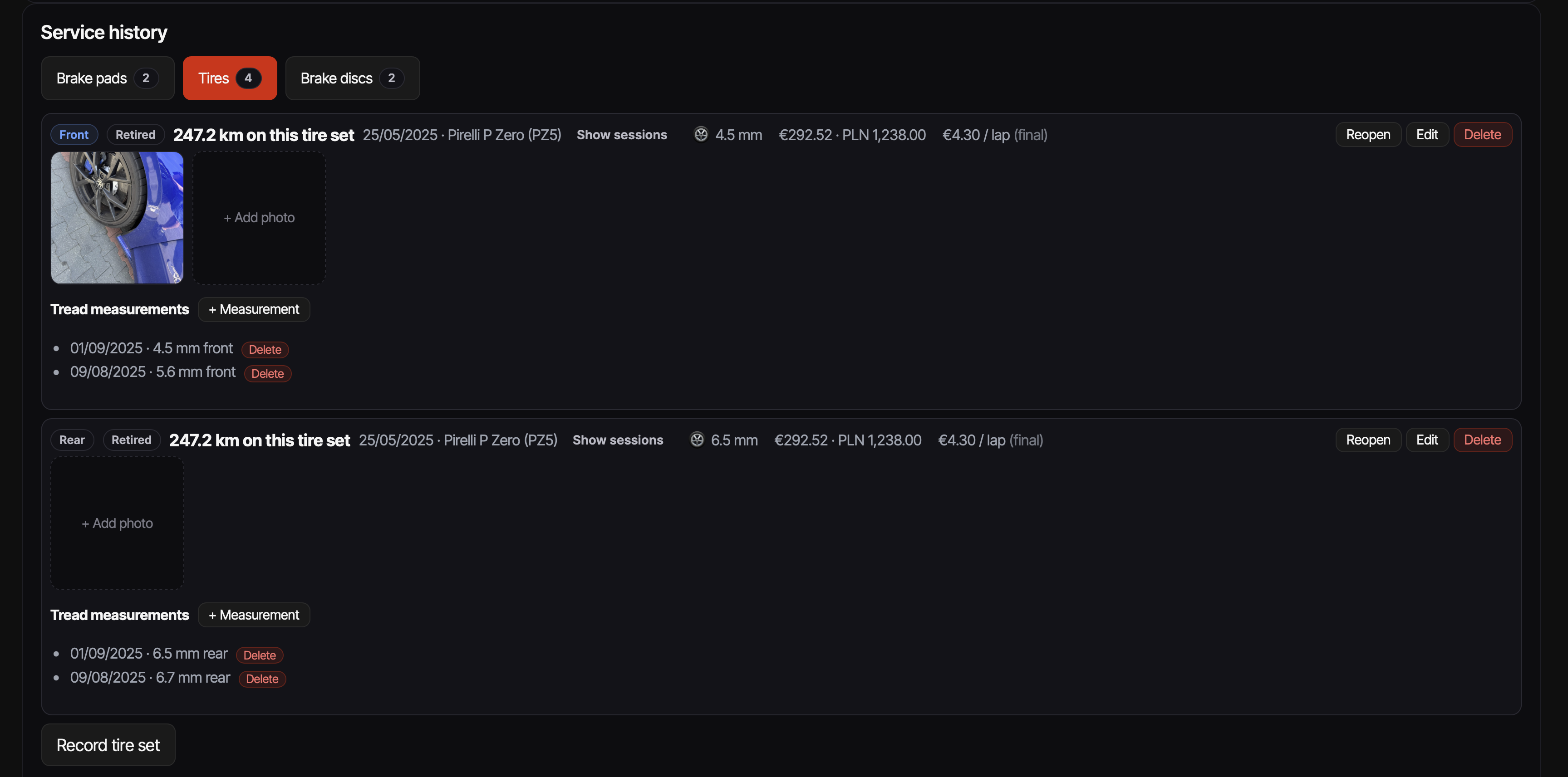
I entered the price once, marked the set retired the day it came off, and the laps were already attributed from the sessions I’d imported over its life. No spreadsheet, no “doing the math.” The car-level figure rolls the same calculation up across every set the car wore.
I’m not going to pretend the tool answers the next question — cost per second gained — yet. That one is genuinely hard and I’d rather ship the honest number than fake the clever one.
Why this is worth keeping
Two things fall out of having the number at all.
First, it makes the season spend legible without a spreadsheet. You stop guessing whether the expensive tires were worth it per lap and start seeing the actual figure — to reason about yourself, not to be told a verdict.
Second, it reframes the cost of the logbook itself. A track day season runs from a few thousand to the better part of five figures; a single entry fee is $250–$700. Against that, the tooling to keep the record is a rounding error — ApexLog’s paid tier is a fraction of one entry fee a year, and the free tier imports a whole season. The point isn’t the price. The point is that the number you spent the season earning — the lap times, the setups that produced them, what each set actually cost you per lap — is worth more than the spreadsheet you keep losing it in.
If you want the longer version of why a season needs a home at all, the track day logbook pillar is the write-up this post sits under. The laps that feed cost-per-lap come from your imported sessions — the RaceChrono import page covers how that part works, with a sample file if you want to see it before exporting your own.
Try it on a set you’re done with
If you’ve got a tire or pad set that’s already off the car, the fastest way to see the number is to enter what it cost, mark it retired, and let the laps you already imported do the division.
Start a logbook with ApexLog →
Free during beta — one closed set is enough to see whether tracking the lap, not the season, is the math worth doing.